Posted on 4 Sep 2026

Benton End

Ahead of his talk at the Garden Museum on Tuesday 15 September, Benton End Head Gardener James Horner looks back over the first summer in Cedric Morris' newly revived walled garden.

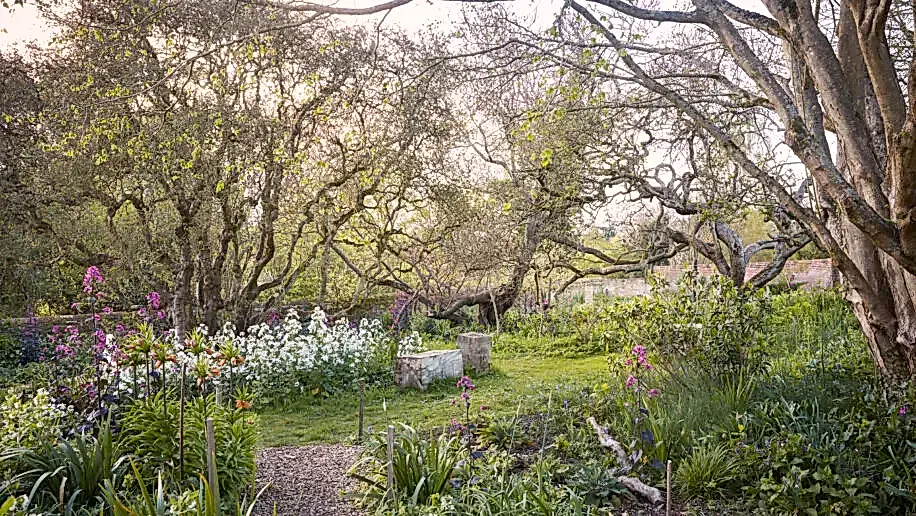
Benton End’s Walled Garden is inherently full of spring delights thanks to the bulbs, aka ‘Cedric’s ghost’, which have survived since Cedric Morris’s gardening days of between 1940 to 1982. With these secured, and the garden’s new layout of paths, terraces and planting areas made, the current principal focus is to increase the variety of summer flowering plants throughout, taking inspired references from ‘Floreat’, 1933’s painting by Cedric with its plentiful summer flowers: hollyhocks, scabious, amaranth, Echinops and sunflowers.

Yet this first summer of the remade garden has been a season of record high temperatures, heatwave after ‘heat dome’ and a summer long drought that has all resulted in gardening being less about new creative inputs and mostly about holding tight, keeping what’s newly planted alive. This July was the driest on record since 1871 across East Anglia, and when that dry atmosphere is coupled with Benton End’s free draining sandy loam soil (much of which was newly denuded of its wild grassy sward in the past year), the resulting environment is a specific one which has amplified the limitations of the garden to me.

A young Agave ferox amongst Diascia fetcaniensis and Hordeum jubatum in the Rubble garden, photo Coralie Thomas

The paired conditions of a dry summer and the free draining sandy loam soil have, I believe, enabled the survival and persistence of Cedric’s Mediterranean bulbs; nutrients leach away from sandy soils, leaving the soil’s vegetation thinner and less competitive, allowing ‘Cedric’s ghost’ to continue to come to the light and occasionally draw the strength to flower. So, the soil is the beauty of the place, and new layers of planting must be suitable to tough it out during barren spells of summer, not be the hungriest for nutrients and not succumb to the forecasted wetter winters.

Looking towards the medlar tree through spikes of Echium vulgare, photo Coralie Thomas

In June, earlier this summer, the garden was truly memorable with thousands of Cedric’s field poppy thriving atop the newly unearthed soil. This planned super bloom moment was made by both planting 1300 seed raised plug plants as well as broadcast sowing handfuls of seed throughout the previous autumn and winter. This quick win worked wonders and the seed bank will now be brimming with tiny poppy seeds. This annual poppy, known as the seed strain ‘Mother of Pearl’, begins to germinate in early autumn as moisture begins to return, both as dew and rain. This is different to late summer annuals, hailing from Mexico, like Cosmos bipinnatus, Tithonia rotundifolia, Ipomoea lobata, which are raised with a spring seed sowing and planted out in the haze of summer. Therefore, on our sandy loam, it takes a not unsubstantial amount of irrigation to get these summer annuals established.

Poppies at Benton End, photo India Hobson

Once our team (Sarah Byham, our Rick Mather Gardener and Sybille de Cussy, our WFGA Trainee) and I began to remove every spent poppy plant, we took the opportunity to deeply water and mulch every newly planted woody plant: Cistus, bare root roses, Phillyrea, etc. Without this mid-season check in I reckon we might have come out of summer with losses. Yet here lies a dilemma, because planting young Cistus in autumn might lead to them suffering from cold and excessive wet through winter. Yet our spring was dry too this year with only 2.5mm of rainfall, recorded in April by our friends over at Beth Chatto Gardens.

Our current tack is to plant in September as autumn rain begins to reinstate moisture in the soil, meanwhile some weeks of warm weather may still further aid establishment. Of the shrubs we haven’t had to show concern for, two stand outs are Buplerum fruticosum and Atriplex halimus, whilst a reoccurrence of the summer flowering Hibiscus syriacus varieties around Suffolk gardens shows its suitability.

Catananche caerulea, Pseudodictamnus mediterraneus and Melica ciliata in the Rubble garden, photo Coralie Thomas

Amidst all this touch and go, trials and observation, there have been clear star performers. Many visitors fell for Cupin’s dart, known botanically as Catananche caerulea, whose lavender blue flowers have shown from late June all the way through the heat of summer. It’s easily raised from seed and so we’ve had many to dot through our newly made rubble garden. The soil typography here is topped with 10-20cm of locally quarried sand (recycled sand would have also been suitable), this is then dressed with chunky aggregate which arose from crushing the flagstones of a terrace made on the site sometime in the 1990’s. The sand has a game changer, in that it keeps the soil beneath cool and prevents moisture evaporation.

No surprises that wild carrot (Daucas carota) has performed well, having probed its tap root deep in the soil. I’ve been surprised with how Succisa pratensis has made it through and now in the first week of September, bears masses of dark purple scabious flowers and is providing nectar to masses of bees, hoverflies and butterflies. Similarly, whilst looking at other local front gardens, Lobelia tupa has seemingly thrived, whilst a lot of the plant literature will conversely recommend growing it in a moist soil.

Verbascum ‘Spica’, Daucas carota and Salvia atropatana, photo Coralie Thomas

Much of the devastation of the drought is in impeding autumn flowering perennials, yet I’m pleased to have found a handful of asters which are proving resilient. Symphyotrichum turbinellum, Symphyotrichum pilosum and Aster ageratoides ‘Ezo Murasaki’ have all remained hydrated and feel revived and ready to go after a deluge this past week.

Summer may always be the hardest nut to crack at Benton End; our soil and regionally dry climate means we’ll lean on Mediterranean flora, much of which goes naturally dormant during summer. September and October feel like our best planting window and already this week we’ve added new plants like Clematis flammula, Cynara cardunculus, masses of a delphinium from Crete, whilst beginning the process of lifting and dividing our Cedric Morris irises. It’s the creative season we’ve worked so hard to get to.

Huge thanks to Sarah Byham and Sybille de Cussy for gardening determinedly throughout a really challenging summer. You’ve grown, perhaps when plants haven’t.

James Horner will be in conversation with Shane Connolly and Ngoc Minh Ngo on Tuesday 15 September. In person tickets are sold out but the livestream is available to watch live or on demand at a time that suits you: book the livestream