Related Events
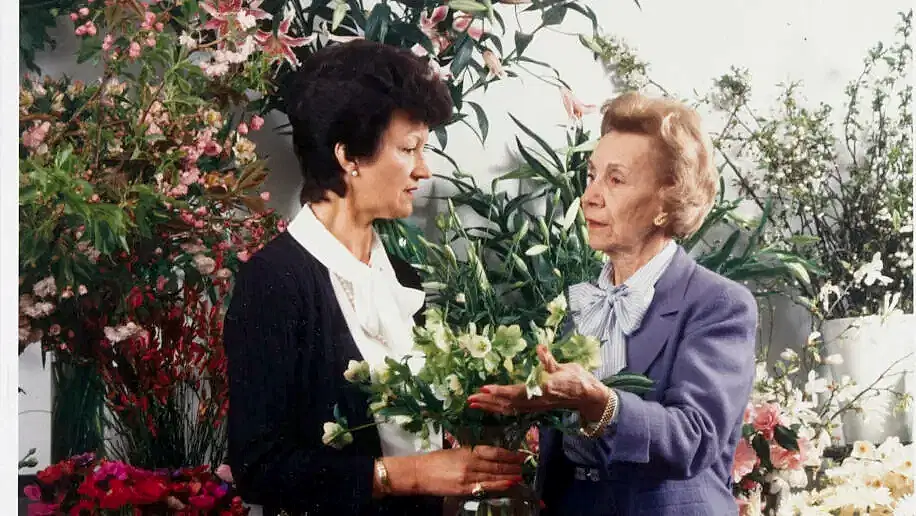
Book Launch | The Amazing Lady P with Sonja Waites and Shane Connolly
29 Sep 2026
Talks

The garden at Lady Pulbrook's country house, Joleswood in Sussex, where she and Sonja picked many of the flowers used in P&G's arrangements.
Pulbrook & Gould created its unique style of decoration based on the flowers grown in the gardens of the country houses of many of its clientele. Until shortly before the outbreak of the Second World War, the large country estates had gardeners who maintained their own cutting gardens of flowers – it was very often the gardener, in fact, who arranged the house flowers. I remember having lunch at Chatsworth with the late duchess, who told me that when she was a young bride the flowers for dinner parties were always arranged by the gardeners behind closed doors and she was not allowed in while this was done. The duchess was clearly unhappy with this state of affairs (and had very different ideas of her own) which she then set out to change gradually, as she did so successfully with many other elements of the estate.

One of Pulbrook & Gould’s special arrangements in their Sloane Street shop: lilies, flanked by smaller displays of lily of the valley, roses and pinks
A couple of decades before Pulbrook & Gould was established, the demands of the war had laid waste to many flower gardens, as the government urged the nation to Dig for Victory to ensure that supplies of vegetables could be sourced at home. By 1956, when Pulbrook & Gould went into business, efforts were being made to restore the broken fabric of life in Britain included establishing a return to flower growing, as a new spirit of celebration emerged for the elements of life that would have seemed much too frivolous during wartime. That things had changed was evidenced by a particular example at Cambridge University in 1956, where the decision was made to restore their flower gardens that had been dug up to create allotments in wartime. This decision recognized the very different atmosphere in Britain post-war. As the history of the new Cambridge Botanic Garden relates:
Allotments were out and flowers were in […] a spirit of optimism, excitement and regeneration returned to Britain during the early Fifties. The young Queen Elizabeth II ascended the British throne in 1953. Popular music was literally being shaken up by rock and roll from America, television sets began entering British living rooms and, on the Continent, Christian Dior’s ‘New Look’ introduced soft, flattering, colourful fashions for women. Colour, beautiful shapes and fragrance were also returning to the gardens of Britain.

Cornus, acanthus, hosta and iris leaves with seed-heads and variegated privet and ivy leaves
In the mid-1950s, Covent Garden Flower Market was still in its original home in the centre of Covent Garden. The flowers available then were limited to those from the English growers – among them many private growers as well as commercial outfits. There were some rarer flowers, including wonderful lilies – among them L. speciosum var. rubrum with its wonderfully scented raspberry-coloured curving blooms; L. ‘Royal Gold’, an Asiatic lily with scented white freckled flowers with a gold band; and L. regale ‘Album’ with its white flowers with a yellow throat; along with further varieties that no longer exist.

Lilium speciosum var. rubrum
Pulbrook & Gould also had other exquisitely scented flowers, including freesias, together with many different roses and gardenias, which arrived every week from a specialist nursery. At that time, there were no commercially available hothouse flowers, so arrangements depended much more heavily than they do today on what was seasonally available – which made the business more exciting but also much more demanding.
P & G also had some wonderful flowering shrubs, such as viburnums, berberis, Japonica (Chaenomeles), azaleas and syringas, along with apple and cherry blossom. Seasonal availability was important, of course. Camellias came from Cornwall in late winter and early spring, and Rosa rubrifolia provided wonderful rose trails. We would have seasonal flowers from the borders, such as English sweet peas and paeonies. Azaleas were the autumn/winter flowering plant that we had delivered to the door.

The garden at Lady Pulbrook's country house, Joleswood in Sussex, where she and Sonja picked many of the flowers used in P&G's arrangements.
In later years, changes in the supply of flowers altered what was available. Foliage choice played a key role in Pulbrook & Gould’s natural style of flower arranging (and the kind of foliage available in those days at the Flower Market was very limited) but we were lucky to be able to source almost all of ours from the private gardens and estates owned by Susan’s circle of friends and acquaintances. These were either delivered to us or, where it was convenient, we were able to pick our own. Leonardslee, not far from Joleswood, was one estate where we were allowed to cut foliage from their azaleas, rhododendrons and Leucothoe (a broadleaf evergreen with red-tipped leaves) ourselves. Lady’s mantle (Alchemilla mollis), with its delicate, crinkly-edged, soft greygreen leaves, was another very useful form of foliage, and this we picked from Susan’s own garden, sometimes around 50 to 100 bunches over the weekend.

This simple arrangement in a glass jar by Pulbrook & Gould in the 1960s which is composed solely of cow parsley and grasses – both roadside weeds – shows some of the influence of Constance Spry
We also picked branches from lime trees (Tilia × europaea) when in flower and stripped it of leaves – hence the stripped lime and paeonies available in late spring. We picked from a range of shrubs, such as viburnum and berberis, throughout the year. We also had access to many smaller private growers who bought herbaceous foliage from their gardens. Wild flowers were another frequent feature in our arrangements and much of this we cut ourselves from the side of the road. Cow parsley (which P & G helped to make popular) was found in abundance on the verges of country roads, as was old man’s beard (the wild form of clematis). Orchids became popular in this period – we sold a lot of Cymbidium ones and were eventually able to buy Phalaenopsis and Miltonia. We also sold a lot of flowering houseplants, too, such as gloxinias, streptocarpus, standard marguerites and fuchsias, which are beautiful and not as easy to find today.
Sonja Waites will be in conversation with florist Shane Connolly on Tuesday 29 September at 6.30pm to celebrate the publication of The Amazing Lady P: The Inspiring Story of Pulbrook & Gould and their English-grown Flowers.
Tickets available to attend in person or watch online (live or on demand): book tickets
29 Sep 2026